Multi-Channel Fluid Delivery & Control Module
Independent Control of Multiple Experimental Fluid Lines
A configurable multi-channel platform designed to coordinate independent experimental fluid-transfer pathways through a centralized control architecture.
Depending on the requested configuration, individual channels can be integrated with compatible pumping hardware, tubing circuits, reservoirs, monitoring interfaces and centralized software control.
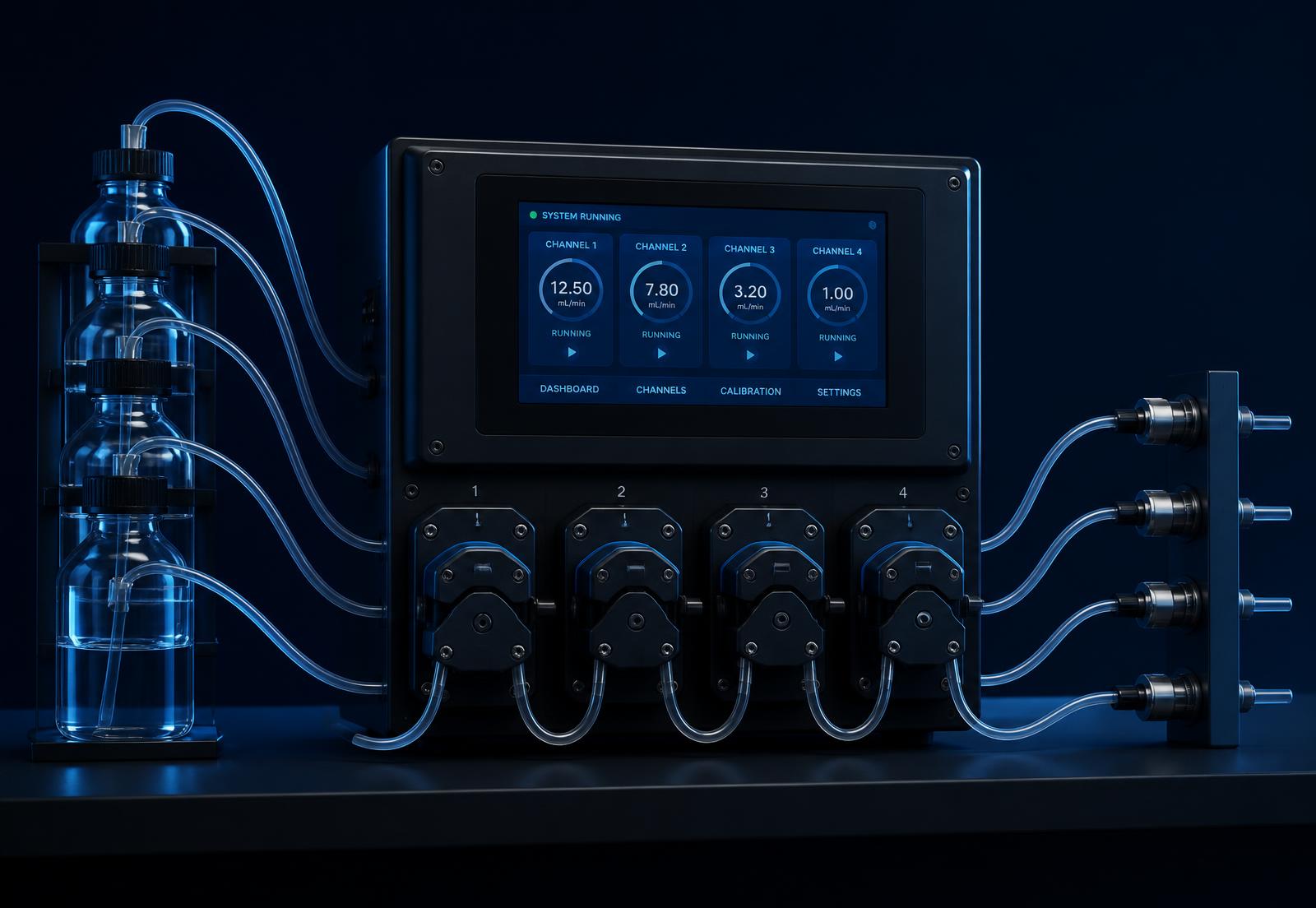
Representative configuration — number of channels, pump hardware, tubing and control architecture depend on experimental requirements.
Why Multi-Channel Fluid Control?
Some experimental platforms require more than one independently managed fluid pathway.
AEP-MF-01 provides an engineering architecture for coordinating multiple experimental fluid-transfer channels through a centralized platform.
Independent Channels
Individual experimental fluid lines can be configured separately.
Centralized Control
Multiple channels can be managed through a unified control architecture.
Modular Expansion
Channel architecture can be configured according to the experimental setup.
System Integration
Fluid delivery can be combined with monitoring, thermal control and other Aeternus Perfusion Lab modules.
Conceptual Experimental Architecture
Optional Monitoring Layer
This diagram is conceptual only and describes experimental laboratory architecture. Channel count, pump selection and monitoring interfaces depend on the requested configuration.
Configure Your Channels
Define your channel architecture, pump technology, control logic and monitoring requirements — our engineering team evaluates the configuration.
Specification Overview
| Product Code | AEP-MF-01 |
|---|---|
| Product Family | Multi-Channel Fluid Management |
| Channel Architecture | Configuration Dependent |
| Number of Channels | Configuration Dependent |
| Pump Technology | Configuration Dependent |
| Independent Channel Control | Optional / Configuration Dependent |
| Sequential Operation | Optional / Configuration Dependent |
| Simultaneous Operation | Optional / Configuration Dependent |
| Flow Monitoring | Optional / Configuration Dependent |
| Pressure Monitoring | Optional / Configuration Dependent |
| Temperature Monitoring | Optional / Configuration Dependent |
| Data Acquisition | Optional / Configuration Dependent |
| Centralized Control | Optional / Configuration Dependent |
| External Interfaces | Configuration Dependent |
| Custom Engineering | Available on Request |
Final channel architecture, pump selection, control functions, monitoring interfaces and operating parameters are defined following engineering evaluation of the requested experimental configuration.
Component Integration
Depending on the selected configuration, AEP-MF-01 may incorporate compatible third-party pumping, sensing or electronic components integrated into Aeternus Perfusion Lab control and experimental system architecture.
Specific component manufacturers and models are determined according to technical requirements, availability and compatibility evaluation.
One Interface. Multiple Experimental Fluid Lines.
Conceptual control interface — final software functionality depends on configuration.
Need More Channels or Custom Logic?
Complex experimental setups may require non-standard channel architectures, sequencing logic, pump combinations, sensor integration or fluid-routing configurations.
Aeternus Perfusion Lab can evaluate custom multi-channel engineering requirements.
Build Your Experimental Fluid Platform
Complete Your Experimental Setup
Planning a Multi-Channel Experimental Setup?
AEP-MF-01 transforms multiple independent experimental fluid pathways into a configurable, centrally controlled fluid-management platform.
Important Information
AEP-MF-01 is presented as a configurable multi-channel fluid-management, integration and control platform for laboratory and experimental engineering applications according to its specified intended use.
It is not presented for clinical use, diagnosis or treatment.
Pump hardware, tubing, sensors, electronics, interfaces, channel architecture and final specifications depend on the individual experimental requirement and engineering evaluation.
Compatible third-party components may be integrated where appropriate.
The system is not described as sterile, medical grade, CE certified, RUO certified or approved unless such status is specifically documented for the supplied configuration.